

It has been nine months since we started Plan A. As one of the co-founders, I’ve been involved in conversations with all of our potential customers. While I’ve spent the last 15 years in the game industry, I’m still learning more about the challenges developers face and what they need in today’s market.
This is the first post in a series from a data perspective on how Plan A Games can help address those challenges, starting with one of the hardest problems in mobile gaming: player lifetime value.
Calculating player lifetime value, or LTV, remains a risky business. That is a math pun, but it is also true. User acquisition is the primary growth engine for most gaming companies, and mature UA teams bid based on cohort lifetime forecasts. That makes LTV forecasting one of the most critical inputs in the business.
- Underestimating LTV preserves margins, but slows growth because competitors can outbid you for the same users.
- Overestimating LTV accelerates short-term growth, but leads to longer payback periods and margin compression.
The system is highly sensitive to error. In practice, the LTV forecast sets the ceiling on how fast a business can grow. Reducing forecast error is a real competitive advantage in an industry that launches hundreds of thousands of products each year.
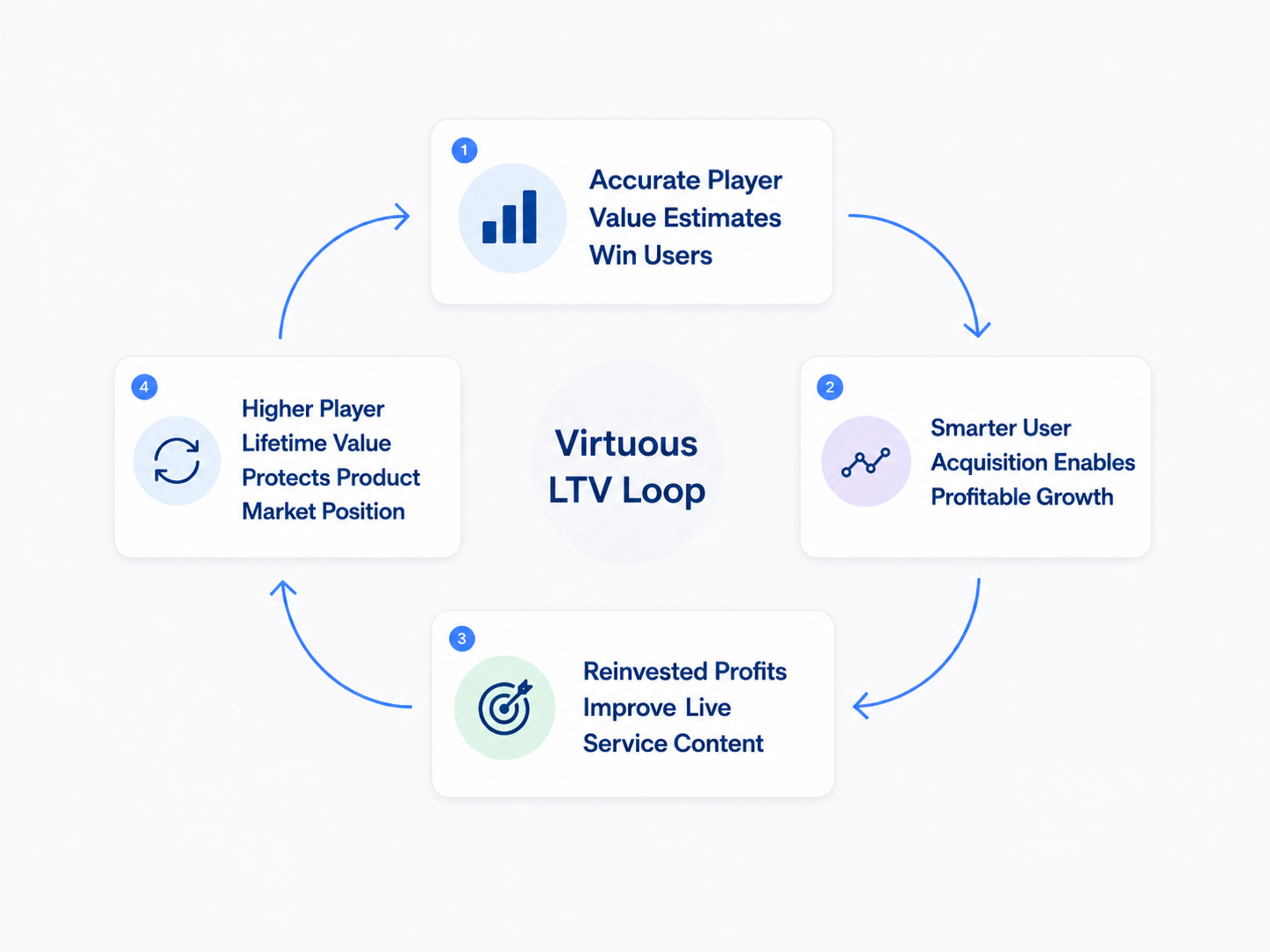
The company with the most accurate LTV estimates can outbid competitors, maximize profit margins, reinvest into the product, increase live service cadence, further improve LTV, and repeat the cycle. This creates a virtuous loop that ultimately leads to a single dominant winner in each genre. Maintaining that position requires efficiently arbitraging between forecasted LTV and CAC to defend market share.
A Career Through the Evolution of LTV
I started my gaming career at Maxis, part of Electronic Arts, fifteen years ago. SimCity was one of my favorite games growing up, so joining the studio was a dream.
Back then, estimating LTV was relatively straightforward. My work focused on unifying player data across entitlement systems so we could connect purchases made digitally, at retail, and later through mobile transactions. When I joined the mobile division to help launch SimCity BuildIt, I evaluated several models. One of the more memorable ones was the “Buy ‘Til You Die” model.
By the time I was at Big Fish, the problem had become much more complex. In free-to-play mobile games, my analytics team built RFM behavioral models to predict LTV, then layered in expected product changes and feature-driven lifts to forecast future revenue. Those models had to absorb player behavior changes caused by product evolution, live ops, and content cadence.
As games become more dynamic, the forecast problem gets harder, not easier. Better products require more iteration, and more iteration introduces more uncertainty into the curve.
From Forecast Error to Lending Design
In my current role, I evaluate incoming product data and LTV curves to determine how we underwrite capital. This is where my experience with forecasting error directly shaped our approach.
Most lending products in the market today are based on cohort lending, where capital is extended against the predicted performance of specific user cohorts. That model assumes a high degree of predictability at the cohort level. It can work in some cases, but it is often restrictive and expensive for products that are scaling or trying to scale.
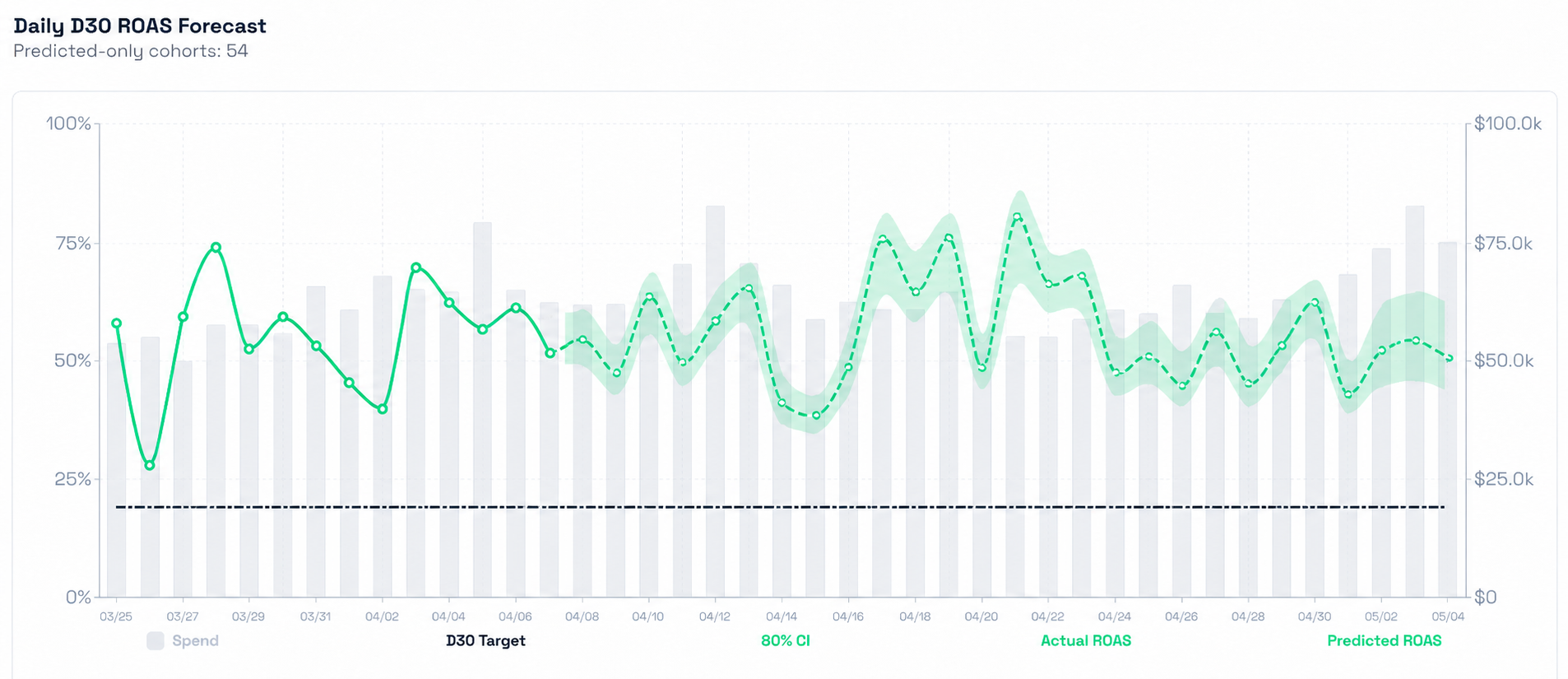
When a game is growing, data is often sparse, noisy, and constantly changing. Teams need to keep A/B testing live ops content, tuning monetization systems, and improving the product if they want to raise LTV over time. That introduces volatility into forecasting, but that volatility is not a flaw in the process. It is part of how growth actually happens.
Forecast error is not something growing teams can eliminate. It is something they have to manage while continuing to experiment.
Cohort-based lending can discourage exactly the kind of creative risk-taking that improves a game. If forecasts miss or experiments fail and payback periods stretch, those structures can limit a studio’s ability to keep investing in growth.
A Different Approach: Lending for Growth
At Plan A Games, we built our product around a different philosophy. Instead of fighting the inherent uncertainty of scaling, we designed around it.
Rather than lending against individual cohorts, we evaluate the full LTV curve dynamically and monitor performance continuously. That lets us adjust capital allocation based on real-time data instead of locking developers into rigid assumptions made too early.
- We recognize that LTV evolves as teams test, ship, and improve their games.
- We account for uncertainty instead of penalizing it.
- We allow flexibility in payback timing when performance deviates from the original forecast.
- We partner with developers on early risk signals so they can react before volatility becomes a real problem.
That creates a different incentive structure. Developers can continue investing in user acquisition and experimentation without being constrained by rigid cohort-based repayment models. In the classic tradeoff between overestimating and underestimating LTV, our model is simply more forgiving when forecasts are wrong, especially in early growth stages.
We all bring our past experience into what we build. My background in analytics and scaling games under uncertainty has shaped how we think about lending. We believe capital should align with the realities of LTV uncertainty, because that is what gives studios the best chance to reach the next level.
If you’re interested in learning more about how we think about UA funding, I’d be glad to talk.
Ready to explore a partnership?
We're looking for mobile free-to-play games with strong KPIs and ambition to scale. If that sounds like you, let's talk.
Get in Touch →