

As Plan A continues learning from our customers, one piece of feedback that’s been unexpected for me: founders appreciate our attractive interest rate, but some are concerned about the downside risk if they are unable to scale within our funding structure.
That feedback surprised me because we built Plan A Games’ lending structure specifically to support developers in the downside case.
If we cannot help our partners achieve the agreed-upon revenue goal, our UA capital behaves similarly to an interest-only loan. In that scenario, our capital becomes one of the lowest fixed-interest-rate funding options in the marketplace with reasonable repayment terms.
From our experience scaling games, there is only one way to truly determine whether a game can scale: take it into the market and invest in it. The perfect storm behind every breakout success, whether it comes from creative breakthroughs like playable ads, gameplay innovation, or the right combination of both, cannot be reliably predicted in advance. Great studios often find their path to success through iterations. They A/B test, learn, adjust, and discover what resonates with players along the way.
Plan A built its lending structure to support the iterative process of growth, while simultaneously avoiding burdens on the business if the game doesn’t reach its ambition. If the game does reach the predetermined revenue target, we earn a small success fee that compensates us for our low-cost funding, downside protection, and support.
Plan A built its lending structure to support the iterative process of growth, while simultaneously avoiding burdens on the business if the game doesn’t reach its ambition.
In this blog, I’ll shed some light on how the Plan A Games structure supports developers as they pursue growth, and how our philosophy around failure helps minimize downside risk for our partners.
It Is Your Plan. We Are Here to Help You Succeed.
A studio can launch a product with new gameplay innovation, but those innovations are often quickly replicated. In the casual genres, we often see similar products launch within 3-6 months of each other. One secret to success, given the intense competition, is to deploy user acquisition as both an offensive and defensive strategy. If a studio is too conservative with UA spend, it may remain profitable on a margin basis, but it also leaves room for competitors to enter the market, acquire users, and capture future revenue. The business goal of user acquisition should be to maximize total profit, not the profit margin on the user acquisition budget.
We help our partners find the point of maximum profits by forecasting potential outcomes given spends and ROAS performance level.
The first step in our process is asking studio partners to provide their spend estimates and forecasted future ROAS curve. This is an important part of the Plan A Games funding structure because our partners set the ROAS targets they believe they can achieve.
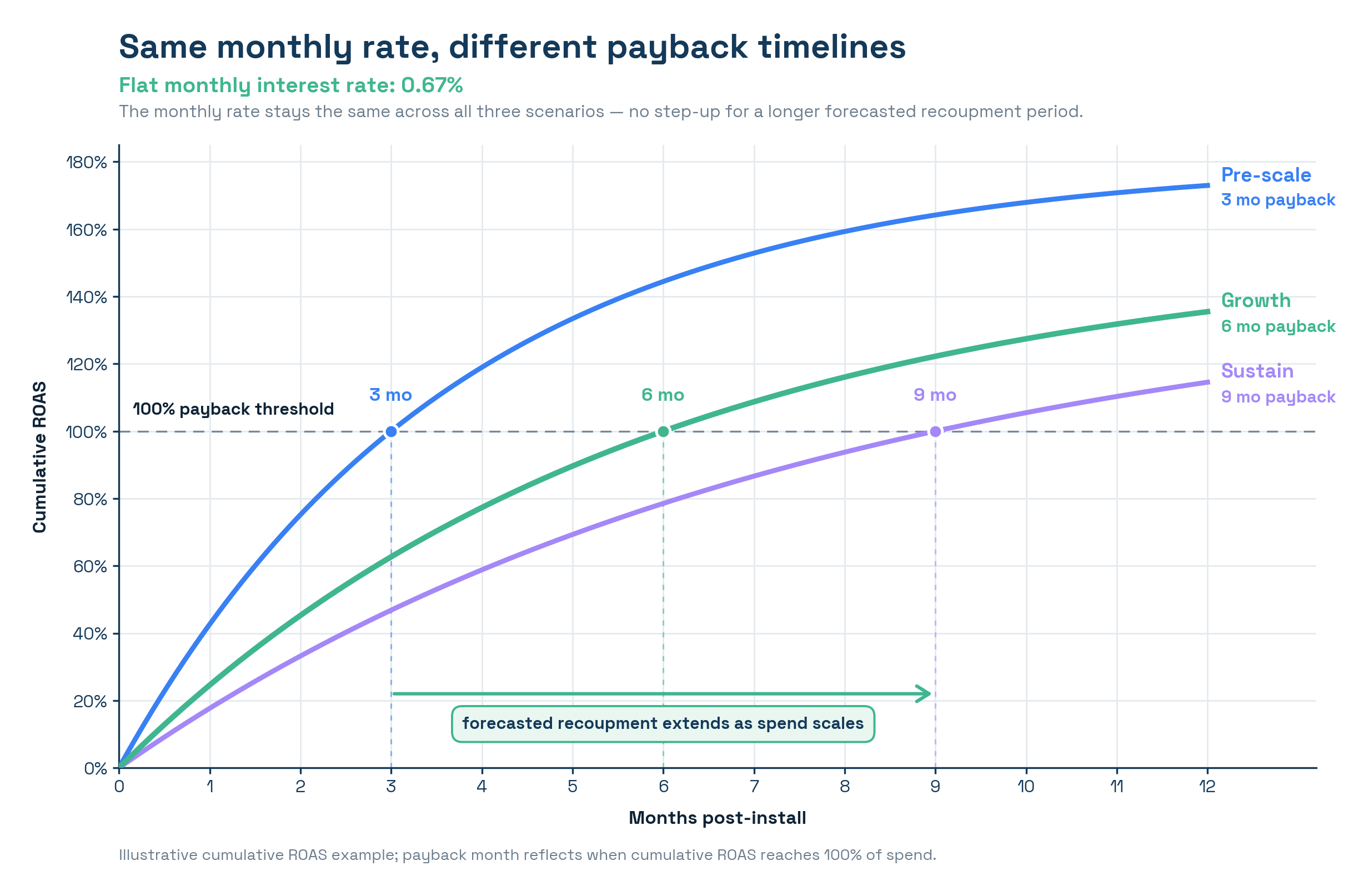
Partners can also model more conservative performance assumptions and longer recoupment periods as they scale the product. What makes Plan A’s structure different is that the low monthly interest rate stays the same even if the studio forecasts a longer payback period. There are no extra costs for extending the forecasted recoupment period, because Plan A funding structure is designed for the realities of scaling, where payback periods can naturally extend as spend increases.
The benefit to the studio profits can be significant. As studios increase spend and push out payback period, ROAS margin on a per monthly cohort may decline, but the studio often drives significantly more total spend across all cohorts, increasing total profits. The financial leverage is even higher when the incremental spend is funded by Plan A fixed interest rate capital. I’ll explore how studio can find the balance between ROAS margin and spend scale in a future blog.
The low monthly interest rate stays the same even if the studio forecasts a longer payback period. There are no extra costs for extending the forecasted recoupment period.
After our partners provide their ROAS targets and planned spend, Plan A constructs a revenue forecast for the product. The partner can then layer their costs on top of our forecast to determine if our structure helps achieve the studio business objectives.
Plan A Games also provides advice and market benchmarks throughout this process to ensure that our partners have the right measurement framework in place to protect against downside risks of over-scaling or cohort under-performance. Once UA capital is deployed, we monitor performance through our platform and provide ongoing expertise to help our partners make informed scaling decisions.
What Happens When We Try Our Best and Still Cannot Get There?
One of the philosophical cornerstones of Plan A Games is John Wooden’s Pyramid of Success. We believe strongly in Coach Wooden’s idea of competitive greatness, where peace of mind comes from knowing you gave your best effort. Even when you give your best effort, there are always factors outside of your control. In scaling mobile games, as in sports or (Mario chess for me), we cannot always predict the outcome.
With that philosophy in mind, Plan A built its structure to support developers in the downside case. If we cannot reach the business targets together, our lending structure defaults to one of the lowest fixed interest rate loans in the marketplace. Our partners know from the beginning of the engagement the costs of capital when things do not go as planned. Additionally, the Plan A Games funding structure allows our partners to forecast for “KPI” cooling and pushback of payback period.
This is a significant differentiator from other forms of user acquisition funding. In other lending structures, the interest rate can become more expensive as the payback period gets longer. The other lenders may even require the borrower to pay back the borrowed fund from the cohort revenue first (no revenue share), constraining the business cashflow.
When a game scales, there are natural and uncontrollable forces that can push out the payback window: audience saturation, shifting player preferences, and increased competition. The more success a game has, the more intense the competition becomes to find qualified players, and the higher the cost to acquire users. When borrowing costs rise while topline revenue declines due to market dynamics, the business takes a double hit.
In the Plan A structure, the business should ultimately be in a better position after funding, whether or not we reach the collective business goal. In the worst-case scenario, our partners receive affordable funding and an opportunity to pursue their ambition. Our downside protection helps ensure there is no “Game Over” moment for our partners. Instead, they have room to iterate, learn, and keep pursuing the path to success.
Our downside protection helps ensure there is no “Game Over” moment for our partners. Instead, they have room to iterate, learn, and keep pursuing the path to success.
Ready to explore a partnership?
We're looking for mobile free-to-play games with strong KPIs and ambition to scale. If that sounds like you, let's talk.
Get in Touch →